

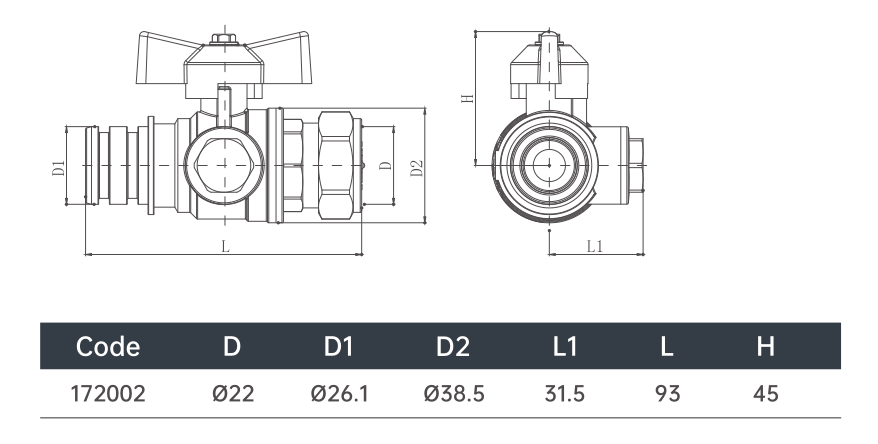
Introduction
Definition and Core Functions
Advantages of Inline Filter Valves
How Inline Filter Valves Work
Key Components and Materials
Types and Configurations
Material Properties and Selection Guide
Sizing and Selection Criteria
Operating Conditions and Performance Parameters
Typical Industrial Applications
Inline Filter Valves are essential components in industrial fluid systems, combining flow control and filtration in a single, compact inline configuration. They ensure clean fluid flow while protecting downstream equipment and reducing maintenance. Inline Filter Valves are widely used in chemical processing, water treatment, HVAC, oil & gas, and manufacturing industries. Their integrated design simplifies piping, reduces leak points, and improves system efficiency. These valves are constructed from durable materials such as stainless steel, brass, or carbon steel, providing corrosion resistance and long operational life.
An Inline Filter Valve is a valve with an integrated filtration element, installed directly in line with the pipeline. It allows fluid to flow while trapping Solid contaminants to prevent damage to downstream equipment.
Core Functions:
Flow Regulation: Open, throttle, or shut off fluid flow.
Filtration: Remove debris, particles, and impurities.
System Protection: Prevent clogging, wear, and corrosion of downstream equipment.
Maintenance Efficiency: Simplifies inspection and cleaning operations.
| Feature | Benefit |
|---|---|
| Compact Inline Design | Saves space and simplifies piping layouts |
| Integrated Filtration | Protects pumps, meters, and equipment |
| Corrosion Resistance | Suitable for water, oil, chemical fluids |
| High Durability | Long operational life reduces replacement costs |
| Easy Maintenance | Filter element accessible without system disassembly |
| Versatility | Suitable for liquids and gases across multiple industries |
Inline Filter Valves combine two key operations:
Flow Control: The valve mechanism (ball, gate, globe, butterfly) regulates fluid flow.
Filtration: Fluid passes through a filter element (mesh, screen, or cartridge) that captures solid particles.
Typical Operation:
Fluid enters the valve inlet.
Flow passes through the valve closure mechanism.
Filter media traps contaminants.
Clean fluid exits the outlet.
Differential pressure indicates when cleaning or replacement is needed.
| Component | Function |
|---|---|
| Valve Body | Houses internal components and connects to piping |
| Filter Element | Stainless steel or other media to trap solids |
| Valve Closure | Controls flow rate (ball, gate, butterfly, diaphragm) |
| Seals & Gaskets | Prevent leakage, maintain pressure integrity |
| Inlet/Outlet Ports | Connect to pipeline |
| Drain/Blowdown Port | Allows removal of debris |
| Actuator/Handle | Manual or automated operation |
| Pressure Gauge Ports | Optional monitoring of differential pressure |
Common Materials:
Body & Internal Parts: Stainless steel, brass, carbon steel
Seals & Gaskets: PTFE, EPDM, Viton
Fasteners: Stainless steel for corrosion resistance
| Type | Description | Typical Use |
|---|---|---|
| Standard Inline | Direct pipeline installation | General fluid systems |
| Y-Type Inline | Angled body reduces pressure drop | Space-constrained pipelines |
| T-Type Inline | Dual paths for alternate filtration | Continuous operation |
| Basket Inline | Removable basket for high solids | Heavy-duty industrial applications |
| Self-Cleaning Inline | Automatic backwash removes debris | Continuous operation without shutdown |
| High-Pressure Inline | Designed for high-pressure pipelines | Steam, oil, gas applications |
| High-Temperature Inline | Handles elevated temperatures | Chemical, thermal, HVAC systems |
| Material | Corrosion Resistance | Temperature Range | Recommended Fluids |
|---|---|---|---|
| Stainless Steel 304 | Good | −20°C to 400°C | Water, mild chemicals |
| Stainless Steel 316 | Excellent | −20°C to 450°C | Chlorides, aggressive fluids |
| PTFE | Excellent | −60°C to 200°C | Chemical seals |
| EPDM | Moderate | −40°C to 150°C | Water, mild chemicals |
Factors to consider:
Flow Rate: Must match system requirements (L/min or GPM)
Operating Pressure: Valve must exceed system maximum pressure
Temperature: Material and seals must tolerate fluid temperature
Particle Size: Select appropriate mesh or micron rating
Connection Type: Threaded, flanged, or welded as per piping standards
Example: For 2-inch inline filter valve with 500 L/min flow at 10 bar pressure and 200-micron filtration, stainless steel construction is recommended for chemical or water treatment applications.
| Parameter | Typical Range |
|---|---|
| Flow Capacity | 5–10,000 L/min |
| Operating Pressure | 0–100 bar |
| Temperature | −20°C to 450°C |
| Filtration Rating | 10–5000 micron |
| Industry | Application |
|---|---|
| Water Treatment | Sand, rust, debris removal |
| Chemical | Catalyst and particle filtration |
| Oil & Gas | Fuel, pipeline, process fluid filtration |
| HVAC | Protect chillers, cooling loops, boilers |
| Food & Beverage | Sanitary filtration, ingredient handling |
| Pharmaceutical | Fluid cleanliness, equipment protection |
| Manufacturing | Coolant, lubrication, and process fluids |
Sed ut perspiciatis unde omnis iste
natus error sit voluptatem
accusantin doloremque
laudantium
info@tsarmatur.se


+46760057388
Copyright © 2023 Ts Armatur, All Rights Reserved
WebbplatskartaDenna webbplats använder cookies för att säkerställa att du får den bästa upplevelsen på vår webbplats.
 English



 Whatsapp
 Telefon