

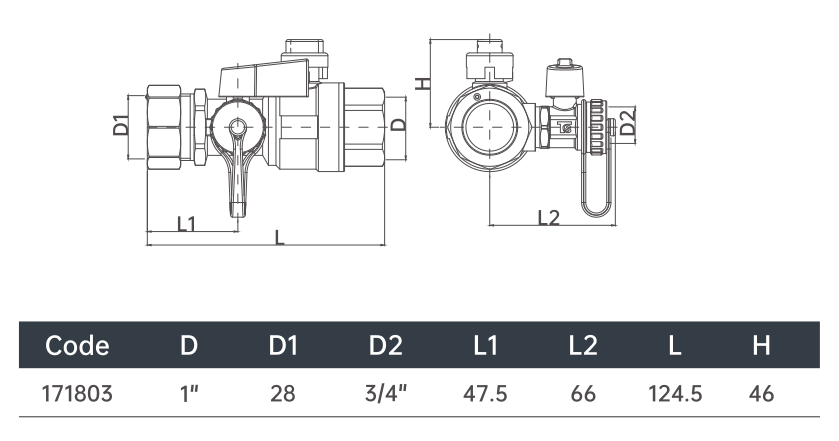
What Are 171803 Ball Valves?
171803 Ball Valves refer to ball valves identified by the numeric code 171803, typically used as a part number, internal catalog number, or reference identifier in industrial inventory systems. While the exact configuration may vary by manufacturer or supply chain source, the industry-standard interpretation of 171803 Ball Valves usually points to a compact, durable shut-off valve designed for fluid isolation and directional control.
In general, ball valves under a reference such as 171803 may include the following common characteristics:
Quarter-turn operation
Positive shut-off performance
Metal or thermoplastic body options
PTFE or reinforced seat materials
Threaded, socket weld, butt weld, flanged, or compression ends
Suitable for water, air, gas, oil, chemicals, and process media
Available in full-port or reduced-port designs
Manual, pneumatic, or electric actuation compatibility
High cycle life in repetitive operation
Low pressure drop in open position
Because many users search for 171803 Ball Valves without having a full technical drawing, a high-quality reference page should explain the functional design, material options, performance parameters, and selection criteria that apply to this valve class.
171803 Ball Valve Definition
A 171803 Ball Valve is an industrial shut-off valve based on the ball valve operating principle, where a precision-machined ball with a central passage rotates inside the valve body to start, stop, or isolate fluid flow. The 171803 designation typically functions as a product code or inventory identifier rather than a universal dimensional standard. Therefore, technical content should describe the common ball valve characteristics associated with such a reference.
A 171803 Ball Valve can be defined as:
A compact or standard-pattern industrial ball valve identified by part number 171803, designed for quarter-turn on/off flow control, tight shut-off, and durable operation in fluid handling systems.
On/off isolation valve
Quarter-turn operation
Low torque actuation
Bubble-tight sealing (depending on seat design)
Minimal internal leakage
Fast response
Low maintenance
Broad chemical compatibility (depending on materials)
Main Features of 171803 Ball Valves
Industrial buyers often evaluate 171803 Ball Valves based on performance and compatibility. Below are the most common features that define this category.
A ball valve opens or closes with a 90-degree handle rotation, allowing operators to quickly isolate lines in emergency, maintenance, or process control conditions.
Ball valves are known for excellent sealing performance. A properly selected 171803 Ball Valve can deliver:
Reliable isolation
Reduced leakage risk
Strong sealing in clean fluid systems
Effective shut-off for compressed air and gas lines
When fully open, the internal bore aligns with the pipeline. In full-port 171803 Ball Valves, the flow path is nearly unrestricted, reducing:
Pressure loss
Turbulence
Energy consumption
Pumping inefficiency
Common body materials for 171803 Ball Valves include:
Brass
Stainless steel
Carbon steel
PVC
CPVC
Bronze
Alloy steel
This allows use in diverse service environments.
171803 Ball Valves are commonly suitable for:
Water distribution
Pneumatic systems
Fuel and oil transfer
Gas handling
Chemical dosing lines
Industrial processing
Utility services
HVAC loops
Steam condensate support lines (depending on design)
Instrumentation systems
Many 171803 Ball Valves use a simple internal design that reduces maintenance complexity. Some variants may feature:
Replaceable seats
Replaceable stem packing
Two-piece or three-piece serviceable bodies
Easy handle or actuator replacement
How 171803 Ball Valves Work
Understanding the operating principle of 171803 Ball Valves helps engineers and buyers select the right valve for system requirements.
Inside the valve body is a drilled spherical ball mounted between seats. The ball is connected to a stem, which connects to a lever handle or actuator.
The hole in the ball aligns with the pipe axis.
Fluid flows directly through the valve.
Pressure drop is minimized.
The ball rotates 90 degrees.
The Solid side of the ball blocks the passage.
Flow stops completely.
Although technically possible, standard ball valves are usually not recommended for prolonged throttling unless specifically engineered for control duty, because partial opening may cause:
Seat wear
Flow erosion
Cavitation risk
Reduced sealing life
171803 Ball Valve Structure and Components
A typical 171803 Ball Valve may include the following core components.
| Component | Function | Common Materials |
|---|---|---|
| Valve Body | Main pressure-retaining shell | Brass, stainless steel, carbon steel, PVC |
| Ball | Rotating closure element | Chrome-plated brass, stainless steel |
| Stem | Connects handle/actuator to ball | Stainless steel, brass |
| Seats | Provide sealing around the ball | PTFE, RPTFE, PEEK, UHMWPE |
| Seals / O-rings | Prevent leakage around stem and body joints | NBR, EPDM, FKM, PTFE |
| Handle / Lever | Manual actuation component | Steel, stainless steel, aluminum |
| Packing | Stem sealing support | PTFE, graphite |
| End Connections | Pipe attachment interface | Threaded, flanged, welded, compression |
| Fasteners | Structural assembly in multi-piece designs | Stainless steel, coated steel |
Common Types of 171803 Ball Valves
Because 171803 Ball Valves may be used as a part-number-based category, it is important to understand the common ball valve configurations available in the market.
Compact design
Economical
Fewer leak paths
Usually not fully serviceable
Common in utility systems
More robust construction
Better maintainability than one-piece
Widely used in industrial systems
balanced cost and durability
Easy inline maintenance
Center section removable without removing end connections
Preferred for cleaning and service-critical applications
Popular in process industries
Internal bore matches pipe ID closely
Minimal pressure loss
Better pigging compatibility
Suitable for slurry or viscous fluids (depending on design)
Smaller internal bore than pipe size
More compact
Acceptable where slight pressure drop is not critical
Female threaded (NPT/BSP)
Male threaded
Socket weld
Butt weld
Flanged
Compression end
Tube fitting end
Tri-clamp (sanitary variants)
Manual lever operated
Lockable handle
Gear operated
Pneumatic actuated
Electric actuated
Spring return actuated
171803 Ball Valve Material Options
Material selection is one of the most important aspects when choosing 171803 Ball Valves.
Advantages:
Cost-effective
Good machinability
Suitable for water, air, oil, and non-aggressive media
Common in utility and general industrial use
Typical Applications:
Compressed air
Potable water (if compliant)
Heating systems
Light-duty industrial fluids
Advantages:
Strong corrosion resistance
Broad chemical compatibility
High strength
Excellent temperature capability
Typical Grades:
304 stainless steel
316 stainless steel
316L stainless steel
Typical Applications:
Chemical lines
Food and beverage support systems
Pharmaceutical utility systems
Marine environments
Outdoor installations
Advantages:
High mechanical strength
Suitable for higher pressure service
Cost-effective for oil and gas or utility duty
Limitations:
Lower corrosion resistance than stainless steel
Often requires coating or controlled environment
Advantages:
Lightweight
Excellent corrosion resistance for many chemicals
Easy installation
Limitations:
Lower pressure/temperature range than metal valves
Not suitable for all solvents or high-heat systems
171803 Ball Valve Seat Materials
Seat material strongly influences sealing performance and temperature range.
| Seat Material | Main Benefit | Typical Temperature Range | Common Uses |
|---|---|---|---|
| PTFE | Excellent chemical resistance, low friction | Moderate to high | General industrial fluids, chemicals |
| RPTFE | Improved wear and pressure resistance | Moderate to high | Higher cycle service |
| PEEK | High strength, high temperature | High | Demanding industrial and chemical systems |
| UHMWPE | Abrasion resistance | Moderate | Slurry/light abrasive media |
| Metal Seat | Extreme temperature and harsh duty | Very high | Steam, abrasive service, severe duty |
171803 Ball Valve Seal and O-Ring Materials
Seals are critical for leak prevention and service compatibility.
| Seal Material | Characteristics | Suitable Media |
|---|---|---|
| NBR (Buna-N) | Good oil resistance, economical | Oils, fuels, air |
| EPDM | Good water and steam resistance (non-oil) | Water, hot water, some chemicals |
| FKM (Viton type) | Strong chemical and heat resistance | Oils, fuels, chemicals |
| PTFE | Broad chemical compatibility | Aggressive chemicals, solvents |
| Graphite | High-temperature support | Steam, high-temp service |
171803 Ball Valve Pressure Ratings
Pressure ratings for 171803 Ball Valves vary depending on body material, size, connection type, and design standard.
| Valve Material / Design | Common Pressure Rating Range | Notes |
|---|---|---|
| Brass Threaded Ball Valve | 600 WOG to 1000 WOG | Common utility rating |
| Stainless Steel Threaded Ball Valve | 1000 WOG to 2000 WOG | Depends on size and design |
| Carbon Steel Flanged Ball Valve | ANSI Class 150 / 300 / 600 | Industrial process service |
| PVC Ball Valve | Lower than metal valves | Strongly temperature dependent |
| Instrument Ball Valve | High pressure service available | Often compact but robust |
WOG = Water, Oil, Gas
Actual pressure capability must always be adjusted for:
Temperature
Media type
Cycling frequency
Safety factor
End connection integrity
Applicable standards
171803 Ball Valve Temperature Range
Temperature performance depends heavily on body and seat materials.
| Valve Construction | Typical Temperature Range | Notes |
|---|---|---|
| Brass + PTFE Seat | Moderate | Good for general utility service |
| Stainless Steel + PTFE Seat | Wide | Popular industrial choice |
| Stainless Steel + PEEK Seat | Higher | For more demanding duty |
| PVC / CPVC | Lower to moderate | Material-limited |
| Metal-Seated Ball Valve | Very high | Severe service applications |
Standard Size Range for 171803 Ball Valves
Although the exact 171803 Ball Valve configuration may differ by catalog, common industrial ball valve sizes include:
| Nominal Size | Inch Designation | Typical Application |
|---|---|---|
| DN6 | 1/4" | Instrumentation, sample lines |
| DN8 | 3/8" | Utility and small pneumatic lines |
| DN10 | 1/2" | General-purpose service |
| DN15 | 3/4" | Water, air, utility piping |
| DN20 | 1" | General process flow |
| DN25 | 1-1/4" | Equipment isolation |
| DN32 | 1-1/2" | Medium flow industrial lines |
| DN40 | 2" | Process and transfer lines |
| DN50 | 2-1/2" | Larger utility and process systems |
| DN65 | 3" | Industrial distribution |
| DN80 | 4" | Main service lines |
In many cases, 171803 Ball Valves as a catalog reference may most often relate to small-to-medium industrial valve sizes, especially in maintenance, MRO, OEM, or process equipment assemblies.
171803 Ball Valve End Connection Types
The end connection type determines installation method and system compatibility.
Common Thread Types:
NPT
BSPT
BSPP
Advantages:
Easy installation
Suitable for small and medium pipe sizes
Popular in maintenance and retrofit work
Advantages:
Strong mechanical joint
Better for larger pipe sizes
Easier disassembly in industrial lines
Suitable for higher pressure classes
Types:
Socket weld
Butt weld
Advantages:
Reduced leak paths
Strong permanent installation
Preferred in high-pressure or vibration-prone systems
Advantages:
Common in instrumentation
Suitable for tubing systems
Precise and compact
171803 Ball Valve Bore Types
A full-port ball valve has an internal bore close to the same diameter as the connected pipe.
Benefits:
Minimal pressure drop
Better flow efficiency
Reduced turbulence
Easier cleaning and pigging
Better for viscous media
A reduced-port ball valve has a smaller internal bore than the pipe size.
Benefits:
More compact
Lower material cost
Lighter weight
Adequate for many utility systems
Advantages of 171803 Ball Valves
The popularity of 171803 Ball Valves comes from the inherent strengths of ball valve technology.
Quarter-turn operation provides immediate isolation.
Ball valves typically provide strong shut-off performance when properly selected.
Manual or automated actuation is generally efficient.
With proper material matching, ball valves can withstand high cycle counts.
Compared with some gate or globe valves, ball valves often save installation space.
Fewer moving parts than many control valve designs.
Suitable for liquids, gases, oils, chemicals, and utility services.
Easy integration with pneumatic or Electric actuators.
Many Industrial Ball Valves support medium to high pressure systems.
Widely preferred where positive shut-off is required.
Sed ut perspiciatis unde omnis iste
natus error sit voluptatem
accusantin doloremque
laudantium
info@tsarmatur.se


+46760057388
Copyright © 2023 Ts Armatur, All Rights Reserved
WebbplatskartaDenna webbplats använder cookies för att säkerställa att du får den bästa upplevelsen på vår webbplats.
 English



 Whatsapp
 Telefon