

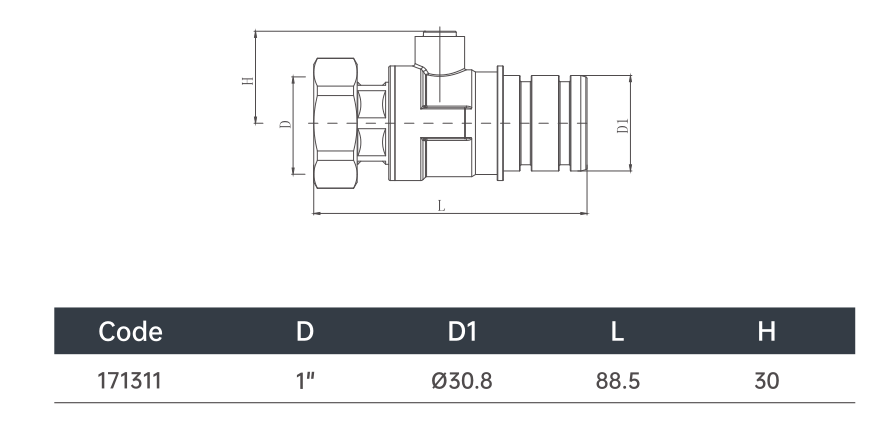
Introduction to 171311 Ball Valves
What Are 171311 Ball Valves?
Main Functions of 171311 Ball Valves
How 171311 Ball Valves Work
Core Components of 171311 Ball Valves
Types of 171311 Ball Valves
Materials Used in 171311 Ball Valves
Seat and Seal Material Options
Advantages of 171311 Ball Valves
Key Performance Characteristics
1. Introduction to 171311 Ball Valves
In industrial pipeline systems, shut-off valves play a critical role in controlling media flow, isolating equipment, protecting downstream components, and maintaining operational safety. Among the many valve types available, 171311 Ball Valves are recognized as a highly efficient and versatile solution for on/off flow control.
The design of 171311 Ball Valves is based on a spherical closure element (the ball) with a bore through its center. By rotating the ball 90 degrees, the valve opens or closes the passage of fluid. This simple but highly effective mechanism allows for fast operation, low pressure drop, and excellent leak-tight sealing.
Because of these advantages, 171311 Ball Valves are frequently selected for systems requiring:
Rapid shut-off
Reliable sealing
compact installation
Resistance to corrosion
Low torque operation
Minimal maintenance
Long service life
The widespread use of 171311 Ball Valves in industrial and commercial systems reflects their suitability for a broad range of media, including:
Water
Air
Steam (within material limits)
Hydraulic oil
Lubricants
Fuel oils
Natural gas
Compressed gases
Mild chemicals
Process fluids
2. What Are 171311 Ball Valves?
171311 Ball Valves are quarter-turn valves designed to control or isolate fluid flow by means of a rotating ball with a central opening. When the bore of the ball aligns with the pipeline, media can flow through the valve. When the ball rotates perpendicular to the pipeline, flow is completely blocked.
The term 171311 Ball Valves may refer to a product model, catalog code, component designation, or industrial identification number used for a specific valve configuration. In industrial content and product indexing, this type of model-based naming is common and useful for differentiating specific body styles, sizes, materials, or end connections.
From a general engineering perspective, 171311 Ball Valves are characterized by:
A robust valve body
Internal rotating ball
Seated sealing surfaces
Stem-operated quarter-turn movement
Straight-through flow path
Tight shut-off capability
Suitability for manual or actuated control
These valves are used primarily as on/off isolation valves, though some systems may use them for limited throttling under appropriate design conditions. However, standard ball valves are typically optimized for full-open or full-closed positions rather than prolonged partial-flow regulation.
3. Main Functions of 171311 Ball Valves
The main purpose of 171311 Ball Valves is to provide secure and efficient shut-off in fluid handling systems. Their operational simplicity and sealing reliability make them ideal for critical isolation tasks.
Flow Isolation
Stops the flow of media completely when closed.
Quick Shut-Off
Allows rapid opening or closing with a 90-degree turn.
System Safety
Isolates sections of piping during maintenance or emergency shutdown.
Leak Prevention
Minimizes fluid leakage through resilient or metal sealing systems.
Equipment Protection
Protects pumps, filters, instruments, and downstream devices by isolating flow when needed.
Operational Flexibility
Can be installed in manual, pneumatic, or electric control systems.
Pressure Retention
Maintains stable shut-off performance under rated pressure conditions.
4. How 171311 Ball Valves Work
The working principle of 171311 Ball Valves is straightforward but highly effective. The valve uses a spherical ball with a hole drilled through its center. This ball is mounted inside the valve body and connected to a stem, which is operated by a handle, actuator, or automation device.
The bore of the ball aligns with the direction of the pipeline.
Fluid passes through the opening with minimal restriction.
Pressure drop is generally low, especially in full-port designs.
The ball rotates 90 degrees.
The bore becomes perpendicular to the pipeline.
The Solid side of the ball blocks the flow path.
The seats press against the ball surface to create a seal.
The ball is partially rotated.
Flow is restricted.
This can create increased velocity and seat wear if used continuously for throttling.
| Valve Position | Ball Orientation | Flow Condition | Typical Use |
|---|---|---|---|
| Fully Open | Bore aligned with pipeline | Full flow | Normal operation |
| Fully Closed | Bore perpendicular to pipeline | No flow | Isolation / shut-off |
| Partially Open | Bore partially aligned | Restricted flow | Temporary adjustment only |
5. Core Components of 171311 Ball Valves
A complete understanding of 171311 Ball Valves requires familiarity with their key internal and external components.
The pressure-containing shell that houses the internal components. It may be one-piece, two-piece, or three-piece depending on service requirements.
A polished spherical closure element with a central bore. The surface finish and material of the ball directly affect sealing performance and durability.
Connects the ball to the operating handle or actuator. The stem transmits rotational force and is often designed with anti-blowout protection.
Soft or metal sealing rings positioned around the ball. Seats ensure leak-tight shut-off and reduce friction during operation.
Used around the stem and body joints to prevent external leakage.
Provides manual operation or connection to electric/pneumatic actuators.
Allow the valve to be integrated into the pipeline system. Common types include threaded, flanged, socket weld, and butt weld.
| Component | Function | Common Material Options |
|---|---|---|
| Valve Body | Pressure containment | Brass, stainless steel, carbon steel, PVC |
| Ball | Flow shut-off / passage control | Stainless steel, chrome-plated brass, alloy steel |
| Stem | Transfers turning motion | Stainless steel, brass |
| Seats | Primary sealing | PTFE, RPTFE, PEEK, metal |
| Packing | Stem sealing | PTFE, graphite |
| Handle | Manual operation | Steel, stainless steel, coated metal |
| End Connection | Pipeline integration | Threaded, flanged, welded, compression |
6. Types of 171311 Ball Valves
Although 171311 Ball Valves may identify a specific product style, industrially they can appear in multiple structural and functional variants.
Compact and economical
Reduced leak paths
Often non-repairable or limited serviceability
Common industrial design
Good balance between strength and maintenance access
Widely used in general systems
Easy inline maintenance
Center section removable without cutting pipe
Preferred for systems requiring frequent cleaning or service
Ball is supported by seats
Common in small to medium sizes
Excellent shut-off performance
Ball is mechanically supported at top and bottom
Better for large diameter or high-pressure systems
Lower operating torque in demanding service
Internal bore nearly matches pipe diameter
Minimal pressure drop
Better pigging and flow efficiency
Smaller internal bore than pipe diameter
More compact and economical
Slightly higher pressure loss
Operated by lever or handle
Fast and simple
Uses compressed air actuator
Suitable for automation
Uses Electric actuator
Useful for remote control systems
| Type Category | Variant | Key Benefit | Typical Use |
|---|---|---|---|
| Body Design | One-piece | Compact | Light-duty systems |
| Body Design | Two-piece | Versatile | General industrial use |
| Body Design | Three-piece | Serviceable | Maintenance-intensive systems |
| Ball Support | Floating | Cost-effective | Standard pressure service |
| Ball Support | Trunnion | High pressure capability | Large or critical lines |
| Port Design | Full port | Low pressure drop | Process lines, viscous media |
| Port Design | Reduced port | Smaller footprint | Utility lines |
| Operation | Manual | Simplicity | Local control |
| Operation | Pneumatic | Fast automation | Repetitive process control |
| Operation | Electric | Remote operation | Integrated systems |
7. Materials Used in 171311 Ball Valves
Material selection is essential for the performance, durability, and safety of 171311 Ball Valves. The right body, ball, stem, and seal materials depend on media type, pressure, temperature, corrosion potential, and maintenance expectations.
Good machinability
Suitable for water, air, light oil
Common in utility and commercial systems
Good corrosion resistance
Suitable for many industrial fluids
Often used in food, water, and light chemical applications
Improved corrosion resistance over 304
Better for chlorides and more aggressive media
Preferred in marine, chemical, and process systems
Strong and pressure-capable
Suitable for oil, gas, and general industrial service
Requires surface protection in corrosive environments
Used for higher pressure or temperature applications
Suitable for more demanding industrial duties
Non-metallic corrosion resistance
Used for certain chemical and water systems
Lower pressure and temperature limits compared with metal valves
| Material | Corrosion Resistance | Pressure Capability | Temperature Range | Common Media |
|---|---|---|---|---|
| Brass | Medium | Medium | Moderate | Water, air, light oil |
| SS304 | High | High | High | Water, chemicals, air |
| SS316 | Very High | High | High | Chemical, marine, process fluids |
| Carbon Steel | Medium | Very High | High | Oil, gas, steam-limited systems |
| Alloy Steel | Medium to High | Very High | Very High | High-pressure industrial service |
| PVC/CPVC | High (chemical-specific) | Low to Medium | Low to Moderate | Water, corrosive chemicals |
8. Seat and Seal Material Options
The performance of 171311 Ball Valves depends heavily on seat and seal materials. These components determine shut-off tightness, friction, wear resistance, and temperature compatibility.
Excellent chemical resistance
Low friction
Widely used
Good for general industrial service
Better wear resistance than standard PTFE
Improved pressure and temperature performance
High-performance engineering polymer
Suitable for higher temperature and pressure
Better mechanical strength
Used in abrasive, high-temperature, or severe service
Longer life in specific conditions
Requires precision design
Low friction
Chemically resistant
Common in standard ball valves
Better high-temperature resistance
Suitable for more demanding thermal conditions
NBR, EPDM, FKM depending on service media and temperature
| Seat Material | Chemical Resistance | Temperature Capability | Wear Resistance | Typical Application |
|---|---|---|---|---|
| PTFE | Excellent | Medium | Good | General industrial media |
| RPTFE | Excellent | Medium to High | Better | Higher cycle service |
| PEEK | Very Good | High | Very High | Demanding industrial systems |
| Metal | Application-specific | Very High | Very High | Severe service |
9. Advantages of 171311 Ball Valves
171311 Ball Valves offer a combination of operational efficiency, reliability, and design simplicity that makes them highly preferred across many industries.
Only 90 degrees of rotation is needed to open or close the valve, enabling quick shut-off.
Properly designed seats provide tight shut-off and low leakage rates.
Full-port designs allow fluid to pass with minimal resistance.
Ball valves are generally smaller and lighter than some alternative valve types.
With proper materials and maintenance, ball valves offer extended operational durability.
Fewer moving parts reduce wear and simplify servicing.
Suitable for water, oil, gas, air, and many chemicals.
Ball valves integrate well with pneumatic and Electric actuators.
Ideal for safety shutdowns and equipment isolation.
Available in designs suitable for medium to high-pressure service.
| Advantage | Benefit to System |
|---|---|
| Quarter-turn design | Faster manual or automated operation |
| Tight shut-off | Better leak prevention |
| Straight-through flow | Lower pressure loss |
| Compact body | Easier installation in limited spaces |
| Durable materials | Longer replacement intervals |
| Low torque | Reduced operator effort |
| flexible connections | Easier system integration |
| Automation-ready | Supports process control upgrades |
10. Key Performance Characteristics
When evaluating 171311 Ball Valves, engineers and buyers typically focus on several important performance factors.
Pressure Rating
Temperature Rating
Seat Leakage Performance
Cycle Life
Torque Requirement
Corrosion Resistance
Media Compatibility
Flow Coefficient (Cv)
Port Geometry
End Connection Integrity
| Performance Factor | Importance | General Expectation |
|---|---|---|
| Pressure Rating | Safety and durability | Must match or exceed system pressure |
| Temperature Rating | Material stability | Must fit operating temperature range |
| Leakage Class | Shut-off quality | Tight shut-off for isolation service |
| Torque | Ease of operation | Lower torque preferred |
| Cycle Life | Longevity | High cycle reliability in repetitive service |
| Cv Value | Flow efficiency | Higher for full-port designs |
| Corrosion Resistance | Media compatibility | Material-dependent |
| Seal Performance | External and internal leak control | Critical for safety and cleanliness |
Sed ut perspiciatis unde omnis iste
natus error sit voluptatem
accusantin doloremque
laudantium
info@tsarmatur.se


+46760057388
Copyright © 2023 Ts Armatur, All Rights Reserved
WebbplatskartaDenna webbplats använder cookies för att säkerställa att du får den bästa upplevelsen på vår webbplats.
 English



 Whatsapp
 Telefon